
B Beltroni Bio
Compute architecture · Autonomous research agent

Beltroni AI de novo drug discovery accelerator service platform

Beltroni AI-Server node installed in a research laboratory
Beltroni AI-Server Cloud Nodes
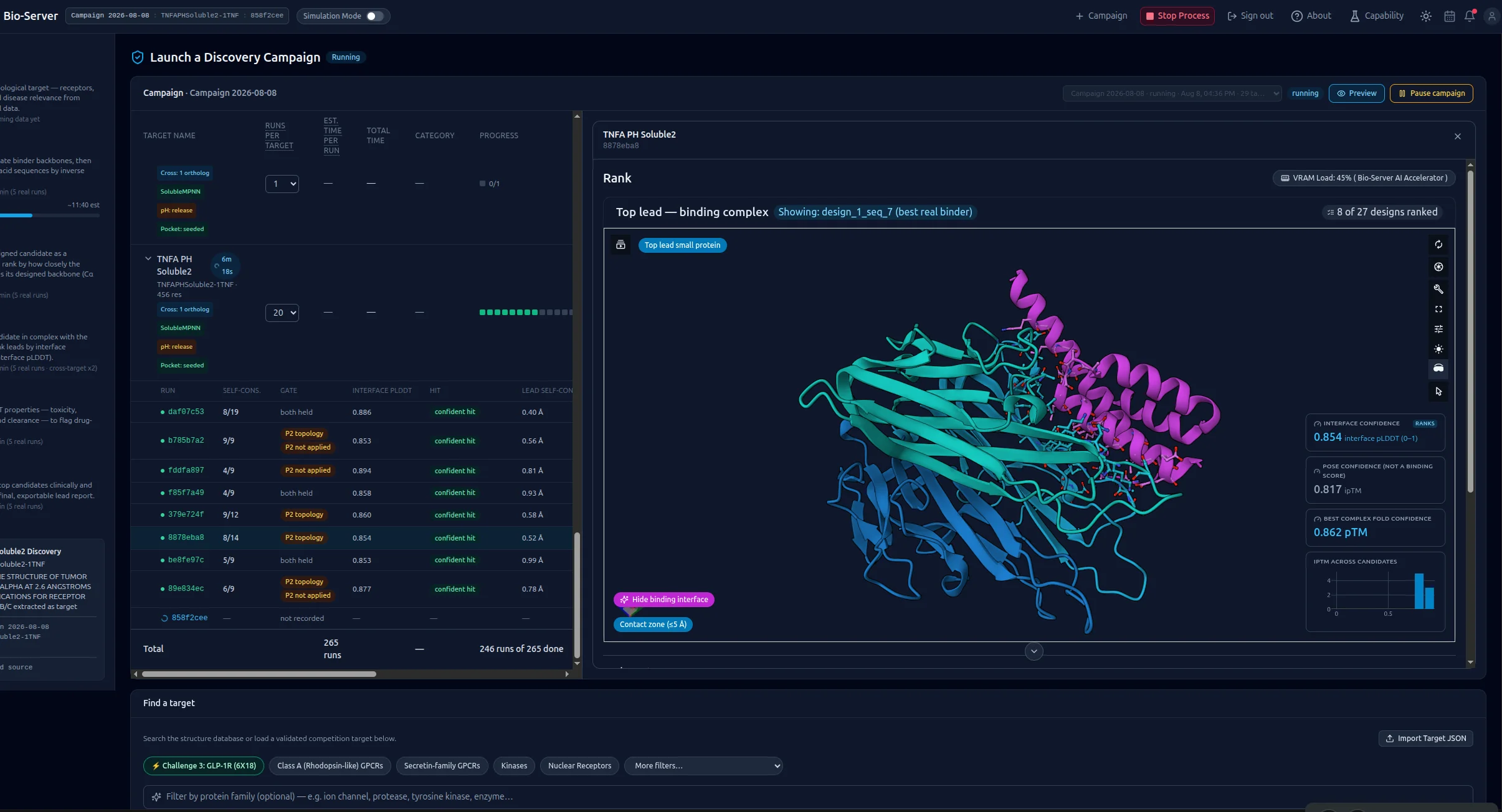
AI-Server campaign dashboard showing Phase 4 ranking and the predicted binding pose of the top lead
Beltroni AI-Server Software

In the rapidly evolving frontier of health science, protein binder design has stood as a complex, time-intensive bottleneck. Today, we are proud to introduce Nikola, powered by our secure AI-Servers — our most advanced Research AI Agent, custom-engineered to accelerate rejuvenation protein binder design and breakthrough health discovery.

AI-Server discovery campaigns

Campaigns run continuously and autonomously, not as one-off runs. Run time scales with target size — a median of 10 minutes, from under 6 for a small target to around 27 for a large one. At continuous operation, a single AI-Server node converts a day of uptime into:

Continuous uptime 24 h
Per discovery run (median) 10 min
By target size 6–27 min
Runs / day at capacity ~140

Each run returns a ranked cohort — typically 7 candidates, up to 8. At capacity that is on the order of 1,000 ranked candidates a day from a single node.

Independent benchmark · September 2026

Three times more binders in the top twenty

We ranked 380 third-party protein designs whose binding had already been measured in a wet laboratory — designs we did not make, results we did not produce. Our top twenty held about three times as many true binders as chance, and on this target our ranking agreed strongly with the field-standard AlphaFold2 pipeline on how the same designs should be ordered, at a rank correlation of 0.73.

No score predicts binding outright, ours included, which is why we never report an affinity. Ranking and design are separate questions, so they are benchmarked separately and published separately.

Contains information from the Adaptyv Bio EGFR round 2 dataset, made available under the Open Database License.

Generative Protein Design · De Novo Discovery

Proprietary skin therapeutics, designed from first principles.

Beltroni Bio operates a balanced, hybrid therapeutic model—coupling an in-house generative biophysics computational engine with internally owned synthetic mini-proteins designed against targets in dermal and skin barrier biology.

Lead biophysical profile — BB-DERM-01 In silico gated
ArchitectureDe novo 3-helix scaffold
Domain targetEGFR ectodomain (EGF-binding interface)
Sequence scale< 80 amino acids
Self-consistency3 / 9 · RMSD 1.39 Å
Interface confidenceipLDDT 0.874
Complex fold confidenceipTM 0.816 · pTM 0.840
Operating framework

The hybrid model

Two things owned outright: the accelerator engine that designs the molecules, and the molecules themselves.

The Discovery Service Engine — Beltroni AI-Server

Built and owned in-house rather than licensed: AI-Server Node, the secure hardware, and AI-Server Software, the discovery accelerator, taking a target to gated candidates in days.

Gating thresholds — platform minimum
Self-consistencyRMSD ≤ 2.0 Å
Interface confidenceipLDDT ≥ 0.80
Complex fold confidenceipTM ≥ 0.50
In silico ADMETLiability pruning

The assets — owned therapeutic pipeline

Value is anchored in internally owned therapeutic candidates, led by BB-DERM-01. Each is validated in stages, cheapest first, so a candidate fails early rather than expensively.

IP positionComposition of matter
ModalitySynthetic mini-protein
ProfileLocalized epidermal delivery
Therapeutic portfolio

Lead regenerative program

Focused de novo lead diversity cohort

Program ID Target & mechanism Primary indication Modality Development stage
LEAD ASSET BB-DERM-01 EGFR ectodomain — EGF-binding interface Dermal and skin barrier biology De novo helical mini-protein (<80 aa) In-silico design and gating complete
Physical validation

Contract research

Physical validation is contracted to specialist laboratories rather than run on in-house capacity, which keeps spend on design and intellectual property rather than on a bench. Named laboratories and their scope of work are published here once engaged.

Delivery engineering

Deformable nanocarrier vehicle

The carrier is designed to avoid systemic capillary uptake and to cross the stratum corneum: an elastic transfersome formulation specified for mini-protein payloads.

Intercellular lipid matrix transit

Single-chain edge activators are used to impart high membrane elasticity, the mechanism by which a vesicle deforms through epidermal pores down to 20nm without rupturing.

Localized epidermal deposition

Intended to deposit mini-protein designs locally rather than through systemic exposure.

Design specification — BB-DERM-01
Thermal stability targetTm > 80°C
Target binding surfaceEGFR ectodomain — EGF-binding interface
Cross-reactivity target>1,000× vs ErbB2/3
NanocarrierElastic transfersome (PC:surfactant)
People

Team

Robert Banegas

Founder & CEO

MSc Computer Science · Neti State Technical University

LinkedIn ↗

From cellular networks to human cells communication systems.

Entrepreneur and life-sciences founder with a strong interest in nutrition, fitness, longevity and health science, developing and deploying AI-driven in-silico drug discovery accelerator engines for de novo protein design aimed at therapeutics and extending healthy human lifespan. His research and development rest on one observation: cells, like networks, are nodes that signal and communicate.

For over 25 years, the medium was telecommunications. I delivered software and hardware for Sony Ericsson, BlackBerry, TracFone, and Trimble Public Safety, spanning scalable IT, AI/ML, embedded systems, and IoT — including a MEMS-sensor platform for human interaction with mobile devices that reached wide commercial adoption.

Created, supervised and co-developed a master’s thesis project at Uppsala University, and completed continued education in parallel computing at PDC, KTH Stockholm.

Author of Refactoring Longevity — chmod +x Biology, the systems engineer’s guide to cellular communication and de novo peptides. It reads ageing as an infrastructure problem: autophagy as garbage collection, biological time-to-live against systemic congestion, genetic switches as operations run on living code.

Investment thesis

Why this cycle is different

The era of AI-driven rejuvenation science is fundamentally unique because it transcends traditional wealth generation. While property, equity, and capital are proven to compound, the ultimate asset required to compound them is time. AI isn't just another digital tool; it is a catalyst for longevity, buying us the exact asset we need to maximize generational wealth.

AI-driven rejuvenation is the computational engine for extending healthspan—delivering more of that ultimate asset: time. This mission is personal: it buys time to keep investing, building, and keeping the people we love active for decades. That stake is what carries us through market cycles that derailed prior trends.

We invite you to build it with us. Beltroni Bio turns that conviction into assets: our Proprietary AI-Server De Novo Discovery Platform, our Owned Mini-Protein Assets, Led by BB-DERM-01, and delivery engineering built for the tissue they must reach. What separates enduring companies is discipline—design, validate, report honestly, and move fast. If that's the company you want to back or build alongside, let's talk.

Property, equity and capital all compound. TIME is what lets us keep compounding them.

Our stage

Late Seed to Series A

Beltroni Bio has surpassed the standard pre-seed technology risk phase. By operating a running de novo drug discovery platform offered as a service, alongside our own proprietary protein assets, we are positioned as a Late Seed/Series A opportunity.

Business model

The “Platform + Pipeline” advantage

The hybrid model approach shifts the risk profile and offers three distinct advantages.

Technology risk already carried

The platform is built and running, so foundational engineering risk sits behind us, and capital goes to biological validation and business development rather than building the engine.

Hybrid revenue timeline

Pure-play therapeutics startups typically burn cash for years before seeing revenue. Our De Novo SaaS allows for near-term cash flow through software licensing and strategic discovery partnerships with pharma, while our owned candidates (led by BB-DERM-01) carry the long-term upside of therapeutic assets we out-license to partners.

The asset generation engine

Investors aren’t just funding a single therapeutic; they are acquiring a stake in a scalable asset factory. The same engine that produced BB-DERM-01 produces the next candidates, adding new proprietary proteins across regenerative and rejuvenation applications.

Platform reach

Benchmarks

Both studies are published in full, including what did not work: design benchmark ↗ and ranking benchmark ↗.

Potential applications

Ordered by how much of our own evidence stands behind each one — not by market size.

Application Standing Why
Therapeutic candidates PRIMARY The intended use, and where nearly all our validated work sits.
CAR and cell-therapy domains EVIDENCED We have validated binders against the class of surface antigen these therapies are built on.
Diagnostic and biosensor reagents EVIDENCED Validated against viral antigens of the class rapid tests detect. Sandwich assays need a pair, so two campaigns.
Precision medicine NOT DEMONSTRATED Discriminating close variants, and scoring at a target’s real operating conditions, are built. Neither is validated.
Delivery-vehicle targeting NOT DEMONSTRATED We design the targeting component only — not the vehicle or its cargo.
Affinity purification reagents NOT DEMONSTRATED Chromatography ligands need properties this pipeline does not optimise for.
Agricultural binders NOT DEMONSTRATED Extrapolated from antifungal and antibacterial compatibility. Not run.

Programme detail is shared under NDA.

Investor enquiries

Programme summaries and platform specifications are shared under NDA.